


Padel and pickleball are two of the fastest-rising sports in America, and they get confused all the time. Both use solid, stringless paddles, start with an underhand serve, and famously social. But step onto each court, and you are playing two very different games.
In 2025, 24.3 million Americans played pickleball, according to the Sports & Fitness Industry Association (SFIA). That same year, SFIA tracked padel for the first time and counted 1,073,000 players. Padel is the newer arrival, and Americans are discovering it fast: the country passed 1,000 padel courts in April 2026, and new clubs open every month.
Why the buzz? Padel is easy to learn, a great workout, and the world’s most social sport. Most first-timers rally within minutes and get hooked by the end of their first match. This guide compares padel vs pickleball side by side, from courts and gear to rules, fitness, and cost, so you can see why so many players are making the switch.
What is the difference between padel and pickleball?
The short answer: padel is a doubles game played inside a glass-and-mesh enclosure, where the ball can bounce off the walls and stay in play. It uses a foam-core racket with at least one hole and a low-pressure, tennis-style ball, and it is scored like tennis. Pickleball is played on a smaller, open court with no walls, using a solid, flat paddle and a light, perforated plastic ball. It has a no-volley zone at the net (the “kitchen”) and games to 11.
If you remember one thing, make it this: in padel the walls are part of the game; in pickleball the kitchen is. Almost every tactical difference flows from those two features.
Padel vs Pickleball at a glance
Here is padel compared to pickleball on every point that matters, with official specs in US units.
| Padel | Pickleball | |
| Court size | 65 ft 7 in x 32 ft 10 in (20 x 10 m) | 44 x 20 ft (13.4 x 6.1 m) |
| Playing area | About 2,150 sq ft | 880 sq ft |
| Enclosure | Glass back walls and mesh side fencing, in play | Open court, no walls in play |
| Net height | 34.6 in center, 36.2 in at posts | 34 in center, 36 in at sidelines |
| Format | Doubles (singles exists but is rare) | Singles or doubles |
| Racket / paddle | Perforated, foam-core, up to 17.9 in long; typically 12–13.5 oz | Solid, flat face; length + width up to 24 in; typically 7.5–8.5 oz |
| Ball | Pressurized felt ball, like a tennis ball with less bounce; about 2 oz | Hollow plastic ball with holes; under 1 oz |
| Serve | Underhand, bounce first, hit at or below waist; two attempts | Underhand, volley or drop serve; one attempt |
| Scoring | Tennis-style: 15-30-40, games, sets | Games to 11, win by 2 |
| Who can score | Either team, every rally | Serving team only (side-out), or either team in rally-scoring formats |
| Signature rule | Ball can be played off the walls after it bounces | No volleys from the kitchen (7 ft no-volley zone) |
| Signature shot | Bandeja, víbora, wall returns | Dink, third-shot drop |
Two things surprise people here. The nets are almost the same height, so the “lower net” difference is tiny. And a padel court has about 2.4 times the playing area of a pickleball court, not just slightly more.
Where each sport comes from
The two sports were born four years apart, both in backyards.
Joel Pritchard, Bill Bell, and Barney McCallum invented pickleball in 1965 on Bainbridge Island, Washington. They improvised with table-tennis paddles, a perforated plastic ball, and a badminton court. Its DNA is badminton, table tennis, and tennis.
Enrique Corcuera invented padel in 1969 in Acapulco, Mexico, building walls around a small court at his home. His friend Prince Alfonso de Hohenlohe took the game to Marbella, Spain, in the 1970s, and from there it spread to Argentina and across Europe. Its DNA is tennis and squash.
How popular is padel vs pickleball in the US?
Pickleball got a head start in the US, but padel is on the rise and already a global phenomenon.
- Pickleball: 24.3 million US players in 2025, up from 4.2 million in 2020, per SFIA. About 7.5 million play eight or more times a year.
- Padel in the US: 1,073,000 players in 2025 in SFIA’s first-ever padel count; 238,000 of them played eight or more times. US courts passed 1,000 in April 2026 across more than 30 states, with Florida, Texas, California, and New York leading.
- Padel worldwide: the International Padel Federation (FIP) puts global players at 38 million across 178 countries and territories. Playtomic counted 58,300 courts worldwide at the end of 2025.
USA Padel tournament activity reflects the same curve: it sanctioned 104 open tournaments in 2025, and the 2026 calendar passed 300.
The takeaway: padel is no longer a sport you only discover on vacation in Spain or Mexico. Clubs are opening nationwide, and one may already be near you. Check where to play padel near you.
Padel court vs pickleball court
The court is the biggest difference between the two sports, and it changes everything about how they play.
The padel court
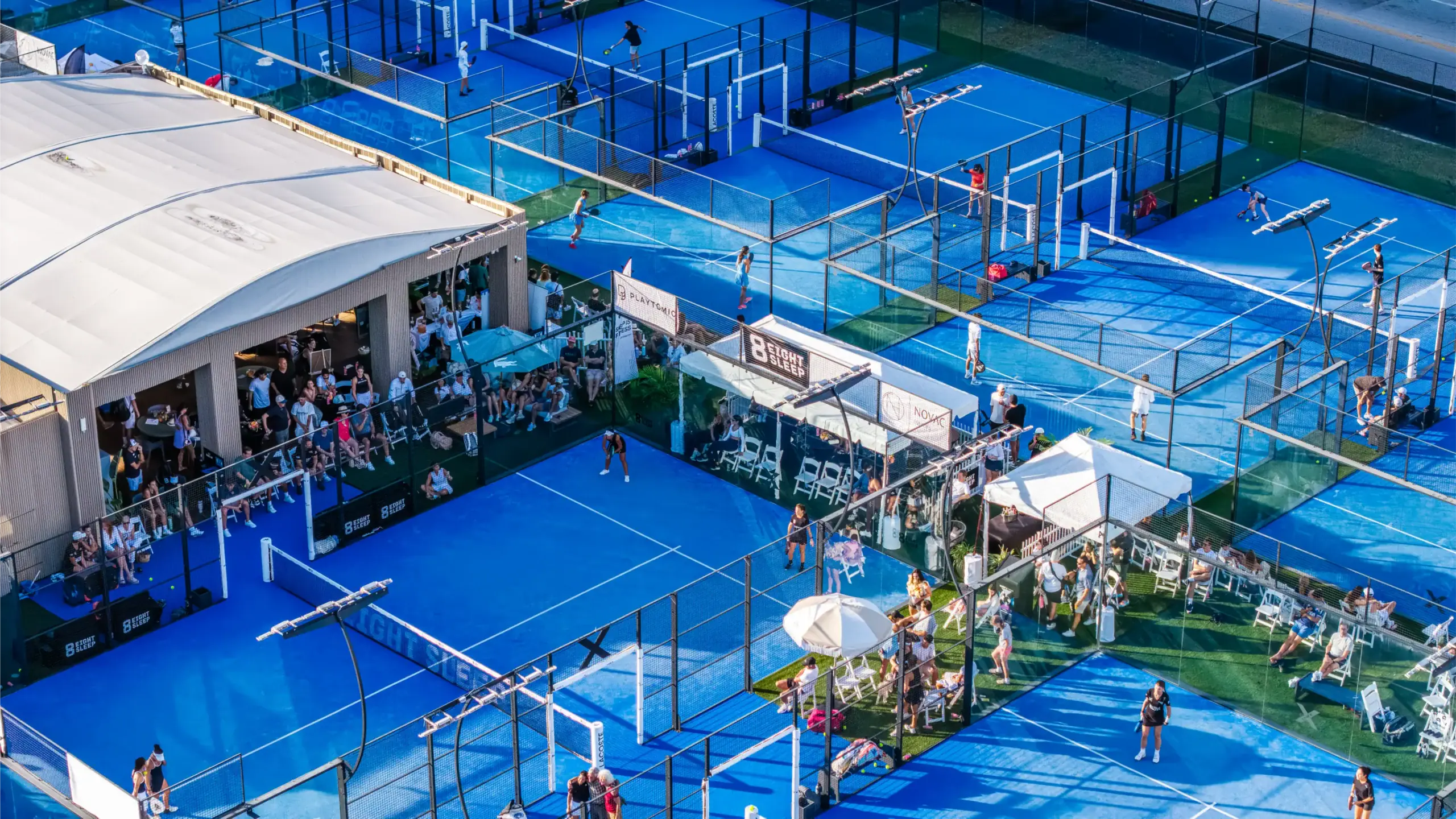
A padel court is 66 x 33ft, split by a net and marked with service boxes. It is fully enclosed. Glass walls 9 ft 10 inches high run across each back wall and wrap the corners. Metal mesh fencing fills the rest of the sides, and at the back it sits on top of the glass, bringing the total height to 13 ft 1.5 in. The surface is usually synthetic turf with sand infill, which keeps footing consistent and the bounce true.
Those walls are not a backstop. They are a playing surface. After the ball bounces on your side, you can let it rebound off the glass and return it. That single rule gives padel its squash-like angles and its long rallies.
The pickleball court
A pickleball court is 44 x 20 ft, the same size as a doubles badminton court. It has no walls in play. Its defining feature is the non-volley zone, or kitchen: a 7 ft strip on each side of the net where you cannot hit the ball out of the air.
Because the footprint is small and open, you can paint pickleball lines on existing tennis courts, gyms, and parking lots. Up to four pickleball courts fit on one tennis court. That is a big reason pickleball spread so fast in the US.
The infrastructure difference
A padel court needs a purpose-built steel-and-glass structure. You cannot play padel on a tennis court with tape lines. That is also part of padel’s appeal: you play in a purpose-built club with great courts, lighting, and a community waiting for you, and more of these clubs open across the US every month.
Padel racket vs pickleball paddle, and the balls
The gear looks similar at a glance, but you cannot swap it between sports.
Rackets and paddles
A padel racket is stringless and perforated, with a foam (EVA or FOAM) core under a carbon-fiber or fiberglass face. Under FIP rules, it can be up to 17.9 inches long, 10.2 inches wide, and 1.5 inches thick. Most weigh 12-13.5 ounces.
- Round: large sweet spot, more control. The best choice for beginners.
- Teardrop: a balance of control and power.
- Diamond: weight toward the top for power smashes; less forgiving.
Padel rackets have a wrist cord, which is mandatory in play. This cord ensures that if you lose your grip on the racket during play, it doesn’t fly away and hurt an opponent or partner.
A pickleball paddle has a solid, flat face with no holes, usually a polymer honeycomb core with graphite, fiberglass, or carbon-fiber skins. USA Pickleball caps its length plus width at 24 in, and its length at 17 in. Most weigh 7.5–8.5 oz, about 40% lighter than a padel racket.
Balls
A padel ball is a pressurized, felt-covered rubber ball. It looks like a tennis ball but has slightly less pressure, so it bounces lower and slower. It weighs about 2 oz.
A pickleball is a hollow plastic ball with 26–40 holes. It weighs under 1 oz. Outdoor balls have more, smaller holes and play faster; indoor balls have fewer, larger holes and play softer.
Shoes
Padel’s sand-filled turf rewards a herringbone style sole for grip on quick turns. Pickleball is played on hard courts, so indoor-court or tennis shoes work well. Padel and pickleball shoes are available, but tennis, basketball, and volleyball shoes also work. Running shoes are a poor choice for both because they lack lateral support, and their grip isn’t suited to a flat court surface.
Padel vs pickleball rules
Both sports start with an underhand serve diagonally across the net, and the ball may bounce only once on the court. After that, the rulebooks part ways.
Key padel rules
- Serve: bounce the ball behind the service line, then hit it at or below waist height into the diagonal box. You get two attempts. A serve that bounces in and then hits the side mesh is a fault; one that hits the glass is good.
- Walls: your shot must bounce on the floor of the opponents’ side before it touches their walls. If it hits their wall first, you lose the point.
- Using your own walls: you may play the ball after it rebounds off your glass, and you may even hit it against your own wall to send it over.
- Volleys: allowed anywhere on court, except on the return of serve, which must bounce first.
- Net: touching the net with your body or racket loses the point.
Full details are in the official USA Padel rules and regulations.
Key pickleball rules
- Serve: underhand, either as a volley or after dropping the ball. It must clear the kitchen and land in the diagonal box. You get one attempt.
- Two-bounce rule: the return of serve and the next shot must both bounce. Only then can players volley.
- The kitchen: you cannot volley while touching the 7 ft non-volley zone, including the line. You can step into the non-volley zone to play a ball that has bounced.
- Doubles serving: in traditional scoring, both partners serve before the serve passes to the other team (except at the start of the game).
Scoring in padel vs pickleball
Padel uses tennis scoring. Points go 15, 30, 40, game. Six games win a set (by two), with a tiebreak at 6-6. Matches are usually best of three sets. Either team can win a point on any rally.
Padel adds a twist at deuce (40-40). Many clubs play the golden point: one deciding point wins the game. On the USA Padel Circuit, and internationally, Star Point is played. Teams play normal advantage twice, and at the third deuce a single point decides it.
Pickleball uses its own system. Games are usually to 11, win by two. In traditional side-out scoring, only the serving team can score. In doubles, the score is called as three numbers: serving team, receiving team, then server 1 or 2. A call of 5-3-2 means the servers lead 5-3 and their second server is up.
Rally scoring is now an approved option in the USA Pickleball rulebook, often played to 15 or 21. Under the 2026 rules, every rally scores, including game point, ending the old “freeze” where you could only win game point on serve. Side-out scoring remains the default for most sanctioned tournaments.
How the games feel: strategy and shots
Both sports are won at the net, but they get there differently.
Padel: patience, angles and the lob
In padel, the team that holds the net usually wins the point, so most rallies are a fight for that position. The defending team stays back near the glass, lets hard shots come off the wall, and lobs over the net players to push them back. Because the walls keep the ball alive, rallies run long, and a ball that goes past a team at the net, or towards the back of court, is often still playable once it rebounds off the glass back wall.
Overhead play is central. Players rarely hit a smash at full power because a hard ball can bounce off the back glass, stay in play, and often give opponents an even easier chance to end the point.
Instead, they use controlled overheads:
- Bandeja: a sliced, flat overhead that keeps the ball low off the glass and lets you hold the net.
- Víbora: a more aggressive, side-spin version of the bandeja.
- Chiquita: a soft, low ball to the net players’ feet, used to win back the net.
- Por tres: Spanish for “by three.” It’s a topspin kick smash that bounces in the opponents’ court, comes off the back glass, and flies out over the 3-meter side wall.
- Por cuatro: Spanish for “by four.” It’s a steep, flat smash hit close to the net. The ball bounces so hard that it goes over the 4-meter back wall, which is the glass plus the fence above it. It’s padel’s version of a slam dunk.
Pickleball: the soft game at the kitchen line
In pickleball, both teams want to reach the kitchen line. The two-bounce rule holds back the serving team, so its key shot is the third-shot drop: a soft arc that lands in the kitchen and lets them move forward. Once all four players are at the net, points become a game of dinks, soft shots into the kitchen, until someone pops a ball up high enough to attack.
Points at the net are often shorter and quicker, with fast hand battles. There is no wall to bail you out, so placement and patience matter more than reach.
What transfers between sports
- From tennis: groundstrokes and volleys help both; padel will feel more familiar because of the scoring and ball. Tennis players must learn to let the ball come off the glass and to swing more compactly.
- From pickleball: soft hands and net instincts transfer well to padel. The new skills are reading wall rebounds and defensive lobbing.
- From squash or racquetball: wall reading gives you a head start in padel.
Is padel easy to learn? Yes, and here’s why
Padel is one of the easiest racket sports to pick up, and unlike many beginner-friendly games, it keeps getting more fun the better you get.
Everything about padel is designed to get you rallying fast. The serve is underhand, so there is no tricky overhead serve to master. The racket is short and solid, with no strings, so it is easy to control. The ball is slower than a tennis ball. And because you play doubles on a compact court, you only cover half the space.
Then there are the walls, padel’s secret weapon for beginners. A ball that gets past you is not lost: let it come off the glass and play it back. That second chance means long, fun rallies from your very first session, not constant chasing of missed balls. Reading the walls and mastering the bandeja come with time, and that is the part players love most. Want to fast-track it? One or two lessons with a certified coach will have you playing confident matches in no time; see USA Padel coaching.
Fitness: which is the better workout?
Padel is generally more demanding; pickleball is the gentler, lower-impact option.
A padel court is about 2.4 times bigger, the ball is heavier, and rallies last longer, so you cover more ground, change direction more, and jump for overheads. Expect a real cardio session. Pickleball still raises your heart rate, especially in fast net exchanges, but it covers less distance, which is why it suits players looking for low-impact exercise.
Both sports are played mostly in doubles, but padel takes the social side further, as the next section explains.
Why padel is called the most social sport
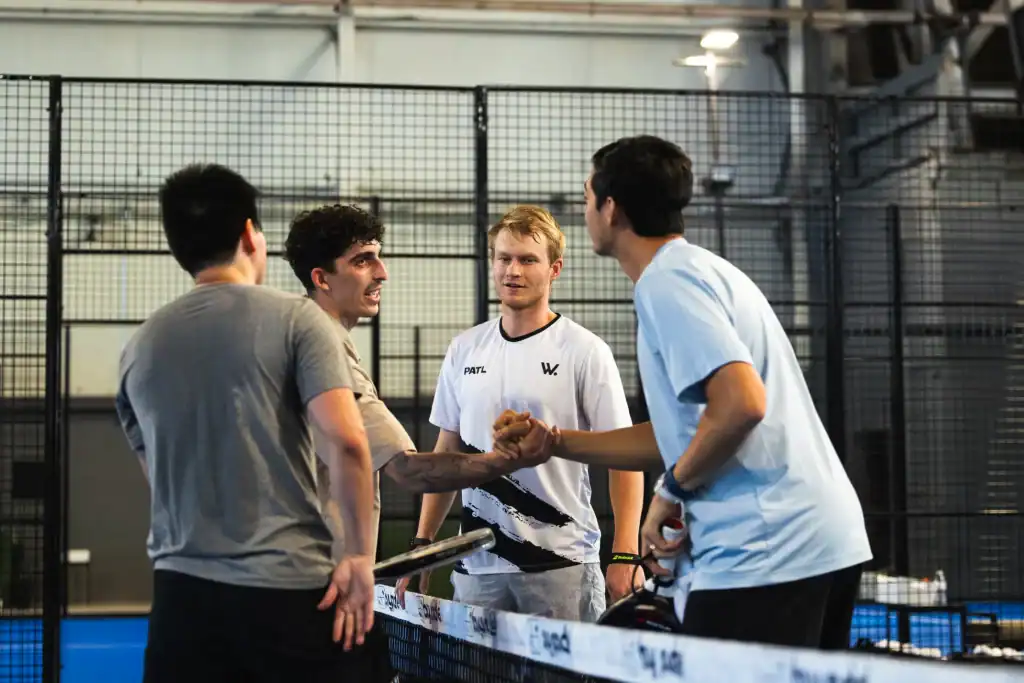
Padel is often described as the most social racket sport, and the way it is built explains why.
- It is always a foursome. Padel is designed for doubles, so every game brings four people together. You are never on court alone.
- Everyone is close. The enclosed court is compact, so all four players stay within talking distance for the whole match.
- Long rallies keep everyone in the game. The walls keep the ball alive, so beginners and mixed-level groups enjoy real points instead of constant restarts.
- Teamwork is built in. Partners move as a unit, cover for each other off the glass and talk through every point.
- Clubs are built around community. Most padel venues are dedicated clubs with lounges, open-match apps and level-based pairing, so it is easy to meet new partners and stay for a drink after the game.
Pickleball is social too, especially its open-play culture in public parks. But padel’s always-doubles format and club setting make it the sport most people pick when the goal is to play with friends and make new ones.
Cost and access in the US
Getting started in padel is easier than you might think: many clubs rent rackets, the court fee is split four ways, and you play in a full club setting.
| Padel | Pickleball | |
| Starter racket/paddle | $80–150 | $40–100 |
| Mid-range / advanced | $150–400 | $100–280 |
| Balls | Can of 3, about 5–8 | About 2–4 per ball |
| Where you play | Mostly private clubs with booked courts, indoor or outdoor | Public parks (often free), rec centers, gyms, clubs |
| Court booking | Paid by the court, usually 60–90 min, split among 4 players | Often free drop-in open play; clubs charge by session |
| Gear rental | Many clubs rent rackets and sell balls on site | Less common; most players bring their own |
Prices are typical US retail ranges as of 2026 and vary by brand, city, and club.
Pickleball still has more courts because it can share existing tennis courts. But padel access is growing fast: the US passed 1,000 padel courts in April 2026, and clubs, hotels, country clubs, and multi-sport centers keep adding more.
To try padel, find a nearby club in the USA Padel directory, book an intro clinic, and borrow a round-shaped racket before you buy one.
Padel or pickleball: which should you play?
If you want a sport that is easy to learn, always social, and a genuine workout, padel checks every box. Plenty of Americans play both, but here is how to decide.
Choose padel if you:
- Want a fast, athletic doubles game with long rallies and a real workout.
- Played tennis or squash and want something familiar but more social.
- Enjoy tactics: angles, lobs, wall play and teamwork with a partner.
- Have a padel club within reach, or want to be early in a fast-growing US sport.
Choose pickleball if you:
- Want the gentlest start and lowest-impact exercise.
- Prefer quick, soft-touch net battles and short points.
- Want singles as a regular option.
The best way to decide is to get on court. Book an intro session at a padel club near you. Most first-timers rally within minutes and book their next game before they leave.
The bottom line
Padel compared to pickleball comes down to two features: padel’s walls and pickleball’s kitchen. Padel gives you the best of both worlds: it is easy enough to enjoy from your first rally, and rich enough to keep you hooked for years. It is fast, social, a great workout, and one of America’s fastest-growing sports. Pickleball has its fans, but if you have not tried padel yet, you are missing out.
Ready to step on a padel court? Find a club near you, check the tournament calendar, and join the US Padel community.