



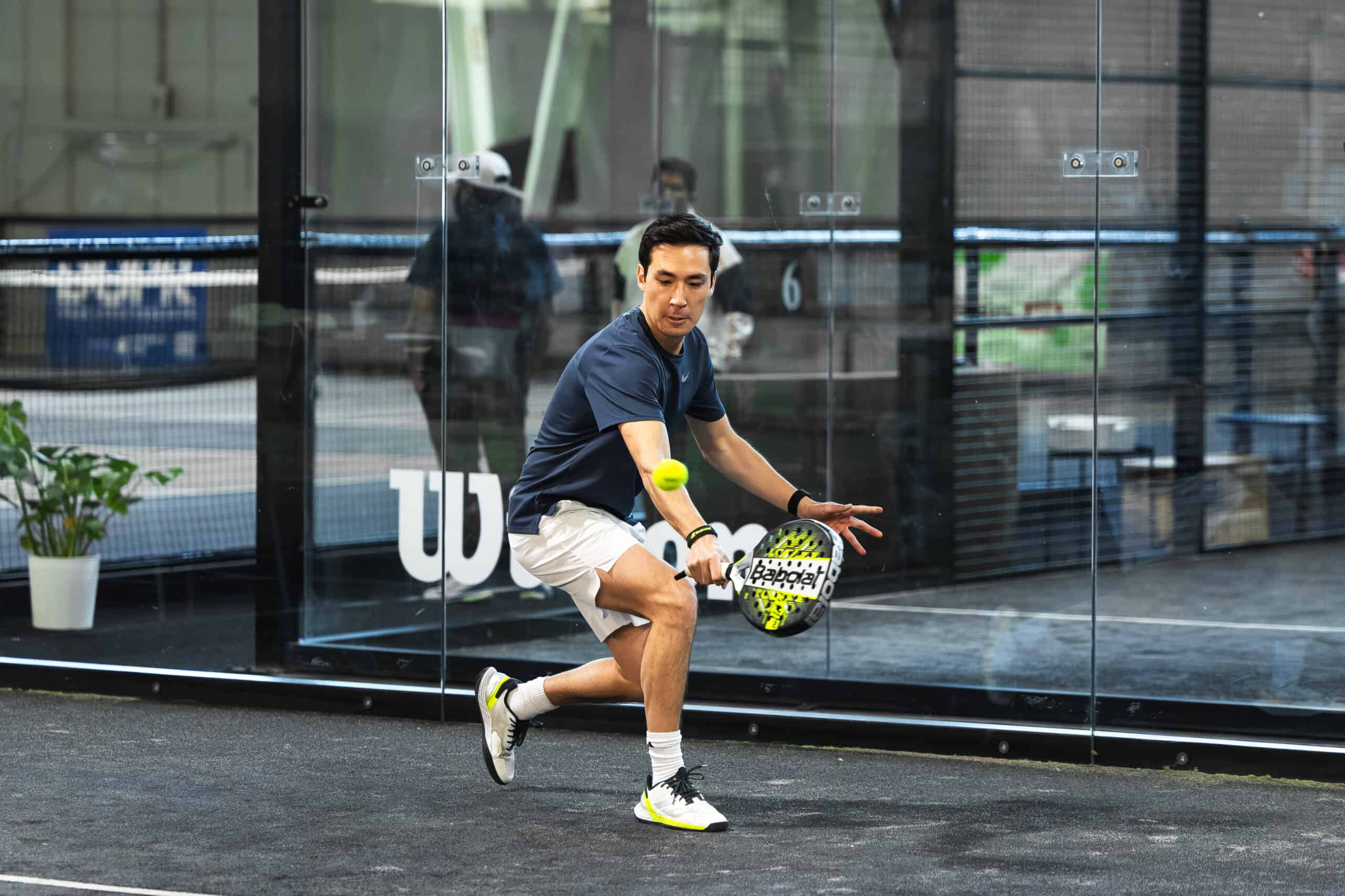
Padel is a doubles racket sport played on an enclosed court about one-third the size of a tennis court, where the glass walls are part of the game. Most beginners can rally within their first hour, which is why it has become one of the fastest-growing sports in the world and is spreading quickly across the United States.
This guide explains what padel is, where it came from, the court and gear you need, how points and matches work, the rules that trip up new players, and the shots and habits that will help you improve. If you have never held a padel racket, you will finish this page ready to book your first game.
What is padel?
Padel (pronounced paddle) is a racket sport that blends tennis and squash. Like tennis, there is a net in the middle, and you score 15, 30, 40, game. Like squash, the court is walled in, and the ball can stay in play after it rebounds off the walls.
You play with a short, solid, stringless racket perforated with holes and a ball that looks like a tennis ball but has less pressure. Every serve is underarm. Because the court is small and the walls slow the ball down, points tend to be long and tactical rather than won by raw power.
Padel at a glance
| Players | Almost always doubles (2 vs 2); singles courts exist but are rare |
| Court | 20 m × 10 m (about 66 ft × 33 ft), enclosed by glass and metal mesh |
| Racket | Solid, stringless, perforated; max 45.5 cm (17.9 in) long |
| Ball | Similar to a tennis ball, slightly lower pressure |
| Serve | Underarm, after one bounce, hit at or below the waist |
| Scoring | Same as tennis: 15, 30, 40, game; six games for a set |
| Signature feature | Balls can be played off the walls |
| Time to learn | Most beginners rally within 30–60 minutes |
A quick note on names: you will see “padel tennis” used, especially in the UK, but the sport’s official name is simply padel. It is also a different sport from American platform tennis and paddle tennis, which use different courts, rackets and balls.
Where padel came from, and why it is booming in the US
Padel was invented in Acapulco, Mexico, in 1969 and reached one million American players in 2025. Here is the short version of how it got from one backyard to more than 90 countries.
- 1969, Mexico. Enrique Corcuera wanted a tennis court at his Acapulco home but lacked the space. He built a smaller court and walled it in so balls would not fly into the neighbors’ yards, and the walls became part of the game.
- 1970s, Spain and Argentina. Corcuera’s friend Prince Alfonso de Hohenlohe built courts at his Marbella club and introduced the game to Spain’s social set. From there, it spread to Argentina. In both countries, padel is now one of the most played sports.
- 1991. The International Padel Federation (FIP) was founded to standardize the rules worldwide.
- 2024. The professional game unified under a single FIP-sanctioned tour, Premier Padel, after it merged with the World Padel Tour.
- Today. The FIP estimates that about 25 million people play worldwide, with courts in more than 90 countries
Padel in the United States
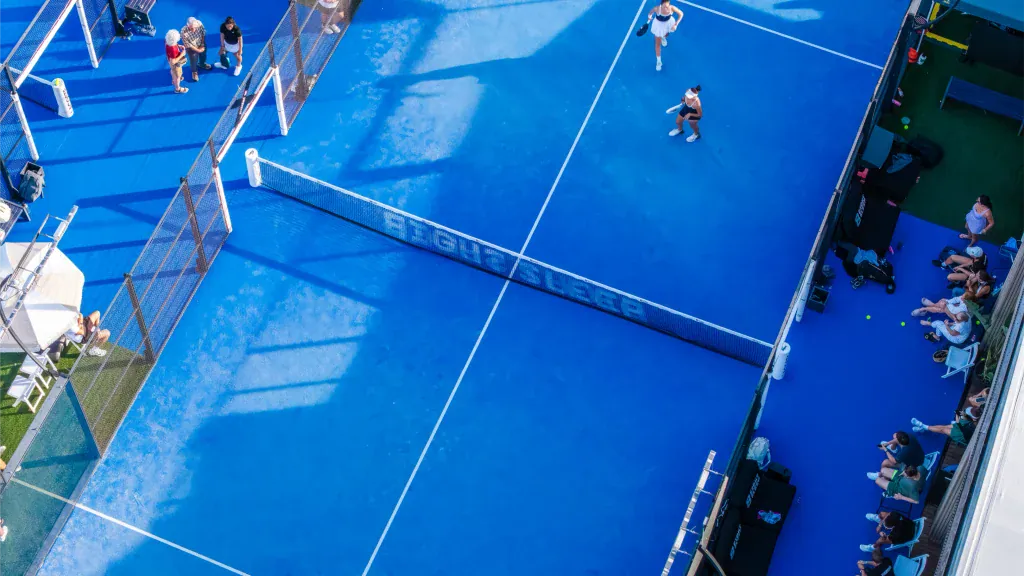
America is now one of padel’s fastest-growing markets. The Sports & Fitness Industry Association (SFIA) tracked padel for the first time in its 2026 Topline Participation Report and counted 1,073,000 Americans who played in 2025. About 238,000 of them played eight or more times that year, as we announced in April 2026.
That happened with infrastructure still in its early days: just over 1,000 courts across 31 states as of April 2026. Our club membership grew 51.5% in 2025, and our sanctioned tournament calendar jumped from 104 events in 2025 to 255 on the 2026 schedule. We project the country could reach 10,000 courts and more than 10 million players by 2030, and we are pursuing an Olympic pathway aimed at Brisbane 2032.
The padel court
A regulation padel court is 20 m long and 10 m wide (about 66 ft × 33 ft), split by a net into two 10 m × 10 m halves and fully enclosed by glass and metal mesh. That is about 200 m² of playing area, versus roughly 650 m² for a doubles tennis court.
| Feature | Specification |
| Playing area | 20 m × 10 m (≈ 66 ft × 33 ft) |
| Net height | 88 cm (≈ 34.6 in) at the center, 92 cm (≈ 36.2 in) at the posts |
| Service line | 6.95 m (≈ 22.8 ft) from the net, about 3 m from the back wall |
| Center service line | Runs from the net to the service line, creating two service boxes per side |
| Back walls | Glass, 3 m (≈ 9.8 ft) high, topped with about 1 m of mesh |
| Side walls | Glass panels near the back corners, metal mesh along the middle |
| Surface | Usually sand-filled artificial turf; sometimes concrete or carpet |
| Exits | Openings at each end of the net, used to leave the court and chase a ball |
The back walls are glass end to end; the side walls are glass only near the corners, with mesh and an exit gap at mid-court.
Three details surprise new players. First, there are no doubles alleys: the full 10 m width is in play from the first point. Second, the lines only matter on the serve; once the rally starts, the walls define what is in and out. Third, the glass and the mesh behave differently. Glass gives a predictable bounce you can play off; mesh gives an erratic one, which is why a ball hitting the mesh directly is often a lost point.
Courts can be indoor or outdoor. Indoor courts are increasingly common in the US because they allow year-round play and remove sun and wind from the equation. Some clubs also have panoramic courts, which use frameless glass so spectators have a clear view.
Equipment: what you need to play
You need three things to play padel: a padel racket, padel balls, and court shoes with good grip. Most US clubs rent rackets and sell balls at the front desk, so for your first session you may only need the shoes.
The racket
A padel racket has no strings. It has a short handle, a foam or EVA rubber core, and a face of fiberglass or carbon fiber, drilled with holes to cut air resistance and weight. Under FIP rules, it can be at most 45.5 cm (17.9 in) long, 26 cm (10.2 in) wide, and 38 mm (1.5 in) thick, and it must have a wrist strap, which you should always wear. Most adult rackets weigh 350–390 g (12.3–13.8 oz).
Rackets come in three head shapes:
| Shape | Balance | Best for |
| Round | Low, near the handle | Beginners; largest sweet spot and most control |
| Teardrop | Medium | Improving all-round players; a mix of control and power |
| Diamond | High, toward the head | Advanced, attacking players; most power, smallest sweet spot |
If you are new, start with a round, softer racket. Diamond rackets are tempting because the pros use them, but they are less forgiving and harder on the arm.
The ball
A padel ball looks like a tennis ball but is slightly smaller and has lower internal pressure, so it bounces a little less and stays playable in a small court. FIP specifications put its diameter at about 6.3–6.8 cm and its weight at about 56–59 g. Do not substitute regular tennis balls: they are too lively and change how the walls play. Balls lose pressure quickly, so most players open a new can every one or two sessions.
Shoes
Padel involves constant short sprints, stops, and lateral moves on sand-filled turf. Padel shoes typically have a herringbone or mixed sole that grips that surface and extra heel cushioning. Running shoes are a common beginner mistake: they lack lateral support and raise the risk of rolled ankles. Tennis shoes work in a pinch, but an outsole designed for clay or for padel grips turf better.
How to play padel, step by step
A padel point starts with an underarm serve and continues until a team fails to return the ball over the net before it bounces twice on their side. Here is how a typical game unfolds.
- Pick sides and positions. Each pair splits the court left and right, and players usually keep that side for the whole match. Right-handers with a strong forehand often take the right (“deuce”) side; the player with the stronger overhead often takes the left (“advantage”) side.
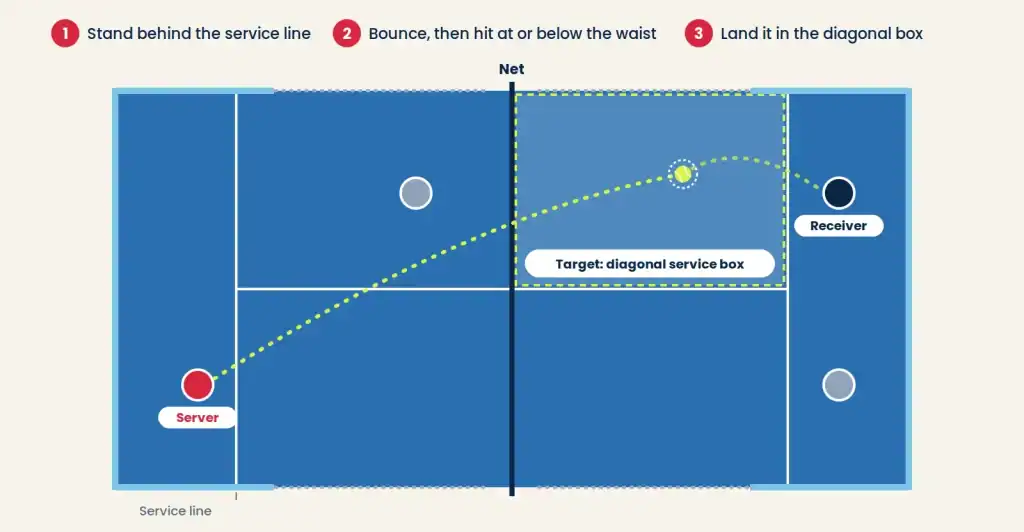
- Serve underarm and diagonally. Stand behind the service line, bounce the ball once, and hit it at or below waist height into the opponent’s diagonal service box. The first serve of each game comes from the right side, then alternates.
- Let the return bounce. The receiver must let the serve bounce once in the box before returning it. After the return, the ball can be volleyed or played after one bounce.
- Use the glass. Once the ball has bounced on your side, it can rebound off your back or side glass, and you can still play it, as long as it has not touched the ground a second time.
- Hit it over the net. Your shot must cross the net and either land in the opponents’ court or hit the ground there first. You can also hit the ball into your own glass so it rebounds over the net, which is legal and occasionally a lifesaver.
- Win the point. You win when the ball bounces twice on the other side, when the opponents hit into the net or out of the court, or when their shot hits your walls or mesh before bouncing on your side.
How scoring works
Scoring follows tennis: points go 15, 30, 40, game. A set goes to the first team to win six games with a two-game lead, and a set tied at 6–6 is decided by a tiebreak to 7 points, won by two. Most matches are best of three sets. Teams switch ends after every odd-numbered game (1, 3, 5 and so on).
What happens at 40–40 depends on the format, so agree on it before you start:
| Format | What happens at 40–40 | Where you will see it |
| Advantage | Win two points in a row; a game can go on indefinitely | Traditional and social play |
| Golden point | One deciding point; the receiving pair chooses which side receives | Common in club and league play |
| Star Point | Up to two advantage cycles; if still level at the third deuce, one deciding point, with receivers choosing the side | All professional play and all USA Padel–sanctioned events since January 2026 |
The Star Point was approved by the FIP in late 2025 and added to the 2026 rules as a compromise between the two older formats. Since January 2026, every USA Padel–sanctioned tournament has used the Star Point, as set out in our official Rules and Regulations. Some event formats also replace the third set with a super tiebreak: the first team to 10 points wins, as long as it leads by two.
Key padel rules and the faults that lose a point
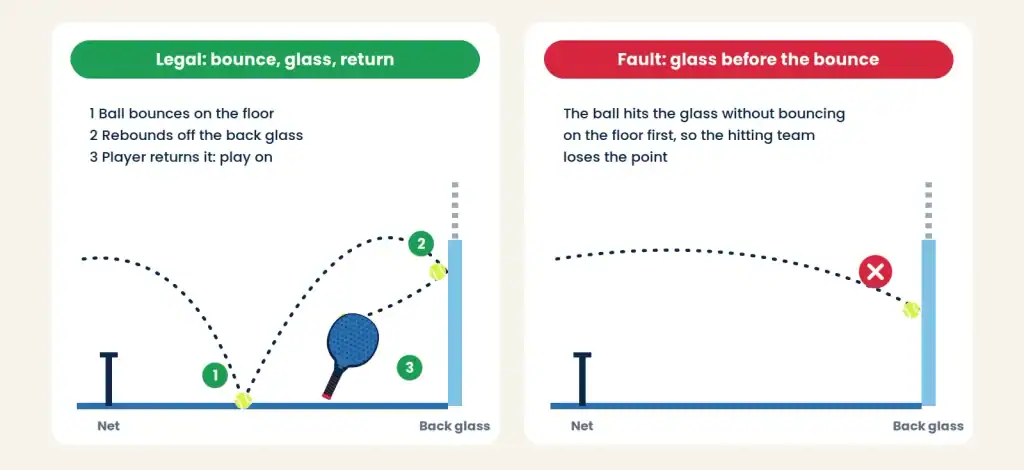
The single most important padel rule is about order: the ball must hit the ground before it hits a wall on the receiving side. Almost every rules question new players ask comes back to that.
Serving rules
- Serve from behind the service line, with neither foot touching or crossing it.
- Bounce the ball once on your side, then hit it at or below waist height.
- The serve must land in the diagonally opposite service box. After bouncing there, it may hit the side or back glass and stay in play.
- It is a fault if the serve lands outside the box, hits the net and stays on your side, or bounces in the box and then hits the mesh.
- A serve that clips the net and lands in the box is a let and is replayed, as long as it does not then touch the mesh.
- You get two attempts. Two faults in a row lose the point.
Walls: what is in and what is out
| Situation | Result |
| Ball bounces on your side, then hits your glass, then you return it | Legal, play on |
| Ball bounces, hits several walls, then you return it before a second bounce | Legal, play on |
| You hit the ball into your own glass and it goes over the net | Legal, play on |
| Your shot hits the opponents’ wall or mesh before bouncing on their side | You lose the point |
| Your shot hits your own mesh | You lose the point |
| Ball bounces twice on your side | You lose the point |
| Ball bounces on the opponents’ side and leaves the court over the walls or through the exits | Opponents may run outside and return it; if not, you win the point |
Other common faults
- Touching the net, the net posts or the opponents’ side with your body, racket or clothing during a point.
- Hitting the ball twice, or both partners hitting it on the same shot.
- Volleying the serve instead of letting it bounce.
- Reaching over the net to hit the ball before it has crossed to your side. You may follow through over the net only after making contact on your side.
- The ball hitting you or your partner, which counts as a lost point.
These are the core rules for recreational play. Sanctioned tournaments follow the FIP Rules of Padel as adapted in our Rules and Regulations.
Essential shots and beginner strategy
Padel is won by the team that controls the net, and most points are about getting there and staying there. You do not need every shot to start, but knowing their names helps you follow coaching and watch the pros.
The shots to know
| Shot | What it is | When to use it |
| Groundstroke (forehand, backhand) | A compact swing after the ball bounces | Rallying from the back of the court |
| Volley | Hitting the ball before it bounces, usually near the net | Keeping pressure on from the net |
| Lob | A high, deep shot over the opponents at the net | The most important defensive shot; pushes opponents back so you can take the net |
| Bandeja | A controlled, sliced overhead hit around shoulder height | Answering a lob while keeping your net position |
| Víbora | A faster, more side-spun version of the bandeja | An attacking reply to a lob for intermediate players |
| Smash | A full overhead, sometimes hit to bounce out of the court | Finishing a short, high ball |
| Chiquita | A soft, low shot aimed at the opponents’ feet | Neutralizing net players so you can move forward |
| Bajada | Attacking a ball as it drops after rebounding high off the back glass | Turning defense into attack |
Five strategy basics
- Move as a pair. Partners should advance and retreat together, as if connected by a rope about 3 m long. A gap between you is the first thing good opponents target.
- Win the net. At the net, stand two to three steps back from it so you can still handle lobs. At the back, stand about a step behind the service line and let the ball come to you.
- Hit through the middle. A ball down the center between two opponents causes hesitation and usually comes back weaker.
- Lob more than feels natural. When both opponents are at the net, a good lob is often the only way to take it from them.
- Play with the glass, not against it. A ball off the back wall has lost pace, which gives you time. Step aside, let it rebound and then play it, instead of lunging early.
The best way to learn these is a beginner clinic. A one-hour group lesson with a certified coach will save you weeks of picking up bad habits.
Why padel is the world’s most social sport
Padel is built for company. Every game puts four people on a court small enough to talk across, and the format, the pace and the culture around it all bring players together.
It is always a foursome. Doubles is the default, so you never play alone, and booking a court means bringing friends or meeting new ones. Splitting the court fee four ways keeps it affordable, too.
You talk the whole time. Partners call “mine” and “yours” on nearly every ball, plan between points and move as a pair. Padel is impossible to play in silence, and that constant communication turns partners into friends quickly.
Everyone is close together. The full court is just 20 m by 10 m, so all four players are within easy talking distance. Between points, you can chat with your opponents as easily as with your partner.
Different levels can play together. The underarm serve, slower ball and walls narrow the gap between strong and new players. Parents and kids, beginners and regulars, and players of different ages can share a court and still have competitive rallies.
It is easy to find a game with strangers. Many clubs run open match systems that pair you with players at your level, so a solo booking becomes a game with three new people.
The game continues after the match. Padel grew up in social clubs in Spain and Argentina, where staying for a drink afterward is so customary that players jokingly call it “the third set.” US clubs are building the same habit with lounges, socials and mixers.
Getting started: mistakes, etiquette and where to play in the US
The fastest way to start is to book a beginner clinic or an open match at a club near you, rent a racket, and wear court shoes. Avoid the handful of mistakes below, and you will be rallying comfortably within a few sessions.
Common beginner mistakes
- Hitting too hard. Power rarely wins in padel. A hard ball rebounds off the back glass and hands your opponents an easy shot.
- Rushing the glass. New players chase the ball into the corner. Stay back, let it come off the wall, then play it.
- Standing too close to the net. It makes you easy to lob. Two to three steps back is safer.
- Ball-watching instead of moving with your partner. Shift together; when your partner is pulled wide, you cover the middle.
- Skipping the wrist strap. It keeps a slipping racket from flying into a partner or the glass.
On-court etiquette
- Call “mine” or “yours” on every ball down the middle.
- Agree before the first serve whether you are playing advantage, golden point or Star Point.
- Wait for a point to finish before walking behind or across a court in use.
- Shake hands or tap rackets at the net after the match. Padel’s culture is social, and most players welcome newcomers.
- Compared to tennis, players make far fewer “in” or “out” calls. Once the serve is in play, the ball is in unless it hits the glass or mesh walls first, or bounces on the turf and then bounces a second time outside the cage. If a ball hits both the turf and the glass at the same time, it is considered in, and the point should continue. If a ball hits the glass first, it’s often very noticeable as it bounces downward.
- Make your own line calls on the serve fairly; if you are not sure, the point goes to your opponents.
Where to play
With just over 1,000 courts across the country and new clubs opening every month, there is a good chance a court is closer than you think. Here is how we can help you get going:
- Find a court: search the US padel club directory.
- Join the community: a USA Padel membership connects you to ranked events and the national rating system.
- Compete: once you are comfortable, browse the tournament calendar for beginner-friendly divisions, or join a local league.
- Learn the official rules: read our official Rules and Regulations.
Most clubs book courts in 60- or 90-minute slots for four players, so the cost is usually split four ways. Many also run “open match” systems in their booking apps that pair you with players at your level, so you can play even if you do not have a full group.
Frequently Asked Questions
Yes. “Padel tennis” is a common nickname, especially in the UK, but the official name is padel. It is not the same as Platform Tennis, which is often called paddle; they are separate sports. However, they share many similarities, so if you enjoy playing paddle, you’ll likely love padel.
No. The underarm serve, small court and slower ball let most beginners rally within their first session. Mastering the walls and tactics takes much longer, which is what keeps players hooked.
Yes, singles padel exists and is played on a narrower 20 m × 6 m court, but it is rare. Nearly all recreational and professional padel is doubles.
Yes, on your own side you may hit the ball into your glass so it rebounds over the net. However, your shot must land on the turf on the other side of the net.
es. Padel combines short sprints, lateral movement and quick reactions, and points last longer than in tennis because the walls keep the ball in play. Because the ball is slower and the court is small, it is also gentler on joints than many racket sports, which makes it popular with players of all ages.
No. Most US clubs rent rackets. Buy one once you have played a few times, and look for a control-oriented model.
It is not recommended. Padel balls are lower pressure and slightly smaller, so they rebound off the glass at the right speed. Tennis balls play too fast in an enclosed court.
It is the 2026 deuce rule used in professional padel and in every USA Padel-sanctioned event. Teams play up to two advantages at 40-40; if the game reaches deuce a third time, one deciding point is played, with the receiving pair choosing which side receives.
Not yet. The International Padel Federation and its 115 national federations around the world are working together on an Olympic Pathway initiative aimed at the Brisbane 2032 Games.
More than one million. The SFIA counted 1,073,000 American players in 2025, the first year it tracked the sport.