



Every sport needs a mountain to climb. For many sports, it’s the Olympics, for soccer or football, it’s the World Cup. For padel, it’s also the World Cup, and every junior player, every weekend tournament, and every early-morning training session in a club across the country is, in some small way, building toward it.
But the significance of the World Cup isn’t really about a single trophy or a single week of competition. It’s about what that goal does for the sport around it, all year, every year.
An Aspirational Goal for Every Level of Play
Ask any competitive padel player in the U.S. what they’re working toward, and eventually the conversation lands in the same place: representing the country. That’s the quiet power of the World Cup. It gives every serious player, whether they’re 14 years old and just starting to travel for tournaments, or 45 and playing some of the best padel of their life, something concrete to aim for.
It’s not an abstract “get better” goal. It’s a real, dated, country-versus-country competition with a roster, a coaching staff, and a jersey. That specificity is what makes it aspirational rather than just aspirational-sounding. A junior player training on a Tuesday night can point to the FIP Junior World Cup and know exactly what standard they need to reach. A weekend warrior in an amateur league can see the Cat Libres pathway and realize that international competition isn’t reserved for professionals. It’s reachable.
Visibility for the Sport on a Global Stage
Padel is still introducing itself to a lot of the United States. Most casual sports fans have heard of pickleball; far fewer have heard of padel, even though it’s exploded across Europe and Latin America. The World Cup changes that equation.
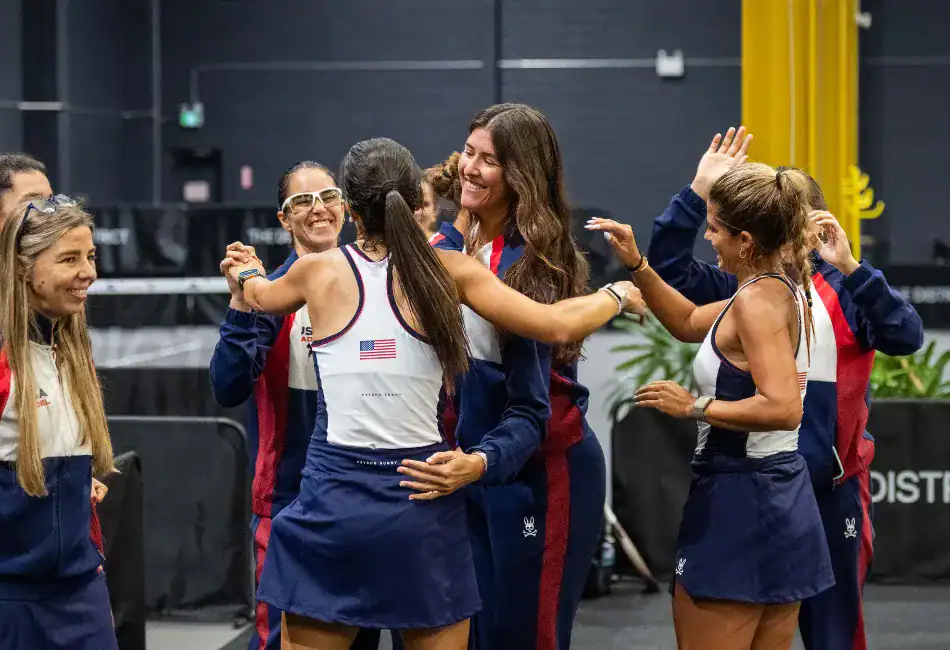
When the U.S. National Padel Team steps onto a court in Doha, Buenos Aires, or Reus, Spain, wearing “USA” across the chest, it puts American padel before an international audience that already understands and follows the sport. It’s a signal to sponsors, to media, and to other federations that padel in America isn’t just a series of local leagues. It’s part of a global competitive structure, governed by the International Padel Federation (FIP) and organized through continental bodies like Padel America, with real stakes and real recognition.
That visibility works in both directions. It also brings the sport’s global energy home, connecting American clubs and players to a padel culture that’s already thriving worldwide: new techniques, new training methods, new rivalries, and a much bigger sense of what’s possible for the sport here.
Connecting the U.S. Padel Community to the World
This is maybe the most underrated part of the World Cup’s significance: it’s a connective thread. A junior player training in Texas, an amateur competing in Florida, and a 55-year-old veteran playing in California don’t often cross paths. But they’re all part of the same national pipeline, all have the potential to wear the same jersey, and all are pointed at the same global competitions. The World Cup, and the broader system of national teams around it, ties the entire U.S. padel community together and links it to the rest of the world’s padel-playing nations.
Why National Teams Matter on Their Own
It’s worth separating this out because the World Cup and the national teams aren’t quite the same thing. The World Cup is an event. The national team system is the structure that exists year-round, and it matters even in years without a World Cup on the calendar.
A national team gives our sport a formal identity above the club level. Instead of talent developing in isolated pockets, it is funneled into one place, evaluated, and coached by experts with deep international experience. That’s what turns a collection of good local players into a program.
It also gives the sport a reason to track players systematically. USA Padel maintains a rankings system based on tournament results throughout the year, and those rankings help determine who gets invited to tryouts and training camps. That means the path onto a national team isn’t a single tryout day. It’s a season-long process, which pushes players to stay competitive and keep improving well beyond any one event.
And for the players who don’t make the final roster, the process still has value. Being evaluated by national coaches, receiving direct feedback, and training alongside the country’s best players raise the level of everyone involved, even those who go home to their local clubs afterward. That ripple effect, more than any single trophy, is why the national team system matters independent of the World Cup itself.
The Different USA National Teams
What’s easy to miss from the outside is that “the U.S. National Padel Team” isn’t one team. It’s several, each built for a different stage of a player’s padel journey. There are four main categories of the US National Padel Team.
Professional / Absolute The Absolute team is composed of the best players holding a U.S. passport and competes in the World Cup, Padel America Cup, and Pan American Championships, typically fielding an eight-player pool from which the coaching staff selects pairs to compete against rival nations. This is the top tier, the team most associated with the World Cup itself.
Amateur / Cat Libres For players who aren’t yet at the Absolute level, the Amateur (Cat Libres) team covers categories two through six and competes in a couples format at the Pan American Open Championships. This category matters because it makes international competition attainable for serious club-level players, not just touring professionals. Many players have transitioned from the Cat Libres Team to the Absolute Team.
Senior (40+ Age Groups) The Senior team is composed of players 40 and older, with age categories moving in five-year increments (40+, 45+, 50+, 55+, and 60+) in the Senior World Cup or a pairs format for the Senior Pan American Championships. FIP Senior World Cups are played country-versus-country across five matches spanning the different age brackets. Pan American Seniors is a pairs format that plays against other countries in its bracket, earning points based on its final position relative to the USA’s overall points total.
Junior (12–18 Age Groups) The Junior team gives players who haven’t yet turned 19 a chance to experience what it’s like to be part of USA Padel and gain competition experience, generally playing in a pool of eight from which the coaching staff selects the strongest pairs. Within Juniors, only the under-14, under-16, and under-18 age categories are considered “official” FIP competitions, and the minimum age to be part of a Junior National Team is 12 years old as of January 1st of the competition year.
How to Play for a National Team
There’s no single shortcut onto a national team, but the process follows a similar shape across all four categories: build a ranking, get seen, get selected.
Rankings come first. USA Padel tracks a points-based ranking system drawn from results across its tournament circuit. Points are weighted by the tournament level and how far a player advances, and those rankings are among the main tools coaches use to decide who gets invited to tryouts and training camps in the first place. Consistently playing and winning USA Padel-sanctioned events is the foundation for getting on a team’s radar at any level.
Juniors go through a formal tryout process. Players register through USA Padel, submit video of their strokes and an uncut match, and are evaluated at in-person tryout events held in different cities around the country. Coaches assess technical skill, tactical awareness, physical fitness, and mental toughness, then narrow the group down over multiple sessions before selecting the final pairs.
Professional and Amateur (Cat Libres) players are pulled from a pool. For the Absolute team, the top-ranked players in the country are called up to a pool, and coaches select the pairs who will represent the U.S. at a given tournament from within that pool. Cat Libres works similarly but at the amateur level, and USA Padel periodically opens applications for players interested in joining ahead of specific international events.
Seniors qualify by age and ranking. Eligibility is based on the age a player turns during the calendar year of the competition, so a player is eligible for the 55-and-over category, for example, from the moment they turn 55 that year. From there, selection again comes down to rankings and performance in front of the coaching staff.
Every category has its own page with current requirements, deadlines, and application links, and USA Padel keeps a full national teams calendar updated as new events are announced. The most reliable place to start is padelusa.org/us-national-team, where players can find the specific pathway for Professional, Amateur, Senior, or Junior.
The Bigger Picture
Take a step back, and the significance of the World Cup comes into focus. It’s not just a tournament. It’s the top of a ladder that starts at a local club and runs all the way to an international final. It gives players of all ages and levels something worth training for. It puts American padel on a stage that the rest of the world already respects. And it ties together a national community of players, coaches, and clubs who might otherwise never share the same court.
That’s why, every time a USA team steps onto an international court, it’s not just five matches being played. It’s the story of a whole sport, still building itself, one national team at a time.