


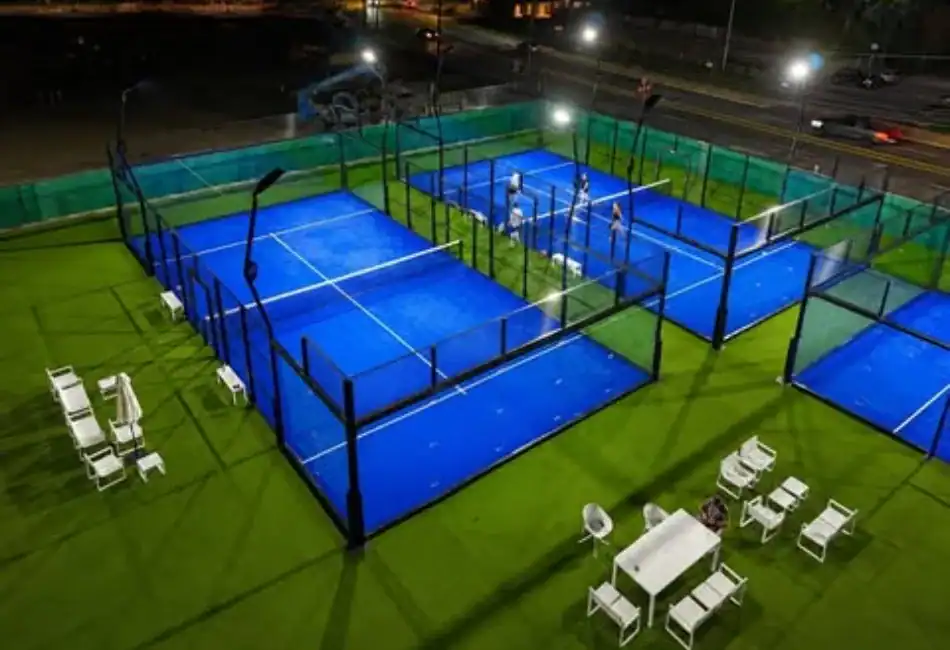
Padel’s growth in the U.S. isn’t just showing up in participation numbers. It’s showing up in construction data. Sportsfield Specialties, a New York-based sports construction manufacturer, recently marked its 100th padel court installation nationwide. USA Padel takes a look at what that milestone actually tells owners and operators about the state of the U.S. market.
Reading the signal behind the number
A single company’s installation count isn’t just a marketing data point; it’s a proxy for how quickly the industry’s supply side is scaling to meet demand. Sportsfield entered the padel market in 2023, positioning itself as the first U.S.-based manufacturer of padel courts. Since then, the company has supplied and installed courts for private residences, racquet and country clubs, resorts, sports facilities, and ground-up developments.
That range of buyers is itself informative. Padel courts are no longer a niche add-on tried by a handful of early-adopter clubs. They’re being built by homeowners, hospitality groups, and multi-sport facility operators alike, which suggests the sport’s appeal spans both recreational and competitive players.
Domestic manufacturing: a practical consideration, not just a marketing angle
For owners comparing suppliers, where a court system is engineered, matters go beyond patriotism or supply-chain optics. Many padel court systems were originally engineered for international markets, which can create friction when a U.S. project needs to clear local wind load requirements and permitting review. A domestically engineered system built with U.S. codes in mind, and backed by engineering documentation, can simplify that approval process, worth asking about directly if you’re comparing vendors for a build.
What does this reflect about market maturity?
A few signals worth noting for anyone evaluating whether now is the right time to build:
- Demand is broadening, not just deepening. Growth isn’t concentrated in one type of buyer; it spans private homeowners to large-scale developments.
- Supporting infrastructure is catching up. A dedicated U.S. manufacturer investing in engineering, project management, and installation teams focused specifically on padel suggests the supply chain is maturing alongside demand, rather than lagging behind it.
- The sport is still early in its U.S. adoption curve. Even with a growing installation base, industry voices continue to describe the market as being in its early stages, which matters for owners trying to gauge competitive saturation in their area versus first-mover advantage.
The questions that matter more than the milestone
A milestone like this is a useful gut-check on timing and vendor selection, not a reason to rush a decision. Before choosing a court manufacturer, it’s still worth asking the same questions that apply to any padel build:
- Is the court system engineered to meet local wind load and building codes, with documentation to support permitting?
- Does the manufacturer have a dedicated team for engineering, installation, and ongoing support, not just sales?
- What does their installation track record look like across facility types similar to yours?
As the U.S. market continues to scale, the operators who ask these questions up front will be best positioned to protect their investment long after the ribbon-cutting.