



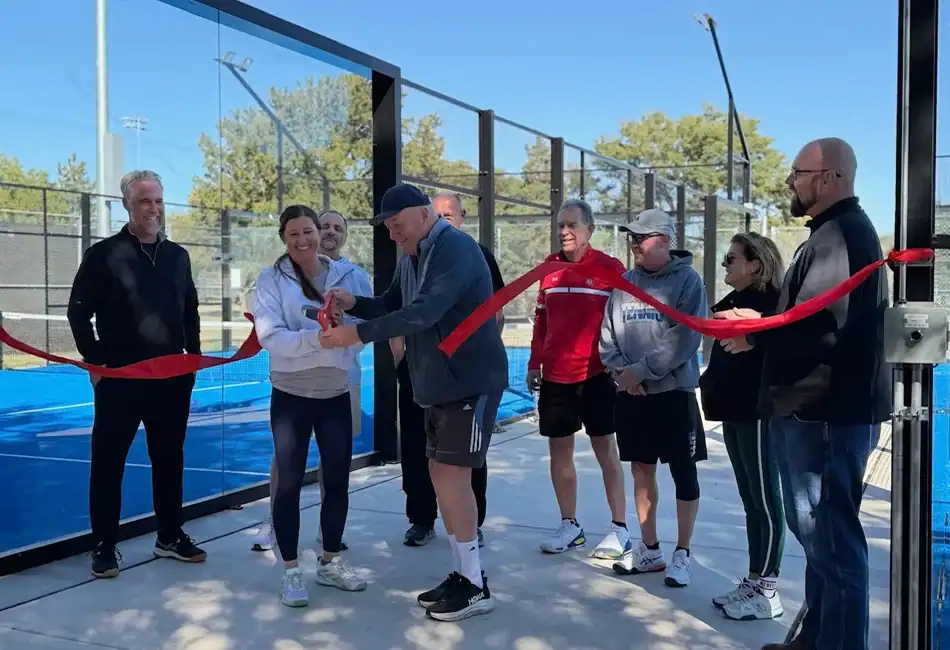
A public-private partnership between the City of Amarillo and a local tennis nonprofit turned a grand slam champion’s pitch into two publicly accessible padel courts.
When Alex O’Brien went to his foundation board with the idea of building padel courts at a public tennis facility in the Texas Panhandle, he knew it was a long shot. “Can you imagine telling a board in Amarillo, Texas, we want to build padel courts?” he says. “However, full credit to our board for being so progressive and having the vision to approve and support this project.”
The support came from a board that has spent more than two decades doing the same kind of work in a region where children growing up in Amarillo’s lower-income neighborhoods do not have a natural path to racket sports. Tennis, as O’Brien puts it bluntly, “is kind of this elitist sport. If you don’t have an entry point, there’s no way to play.” The board’s entire reason for existing is to build that entry point, one program at a time.
As part of the partnership, two lit padel courts opened at the Amarillo National Tennis Center in October 2025; the costs were shared between the City of Amarillo and the foundation O’Brien founded in 1998, with the city investing almost $1 million in the project.
Amarillo Director of Parks and Recreation Michael Kashuba said the city was grateful to the foundation “for helping make these courts possible for the entire Amarillo community to enjoy.”
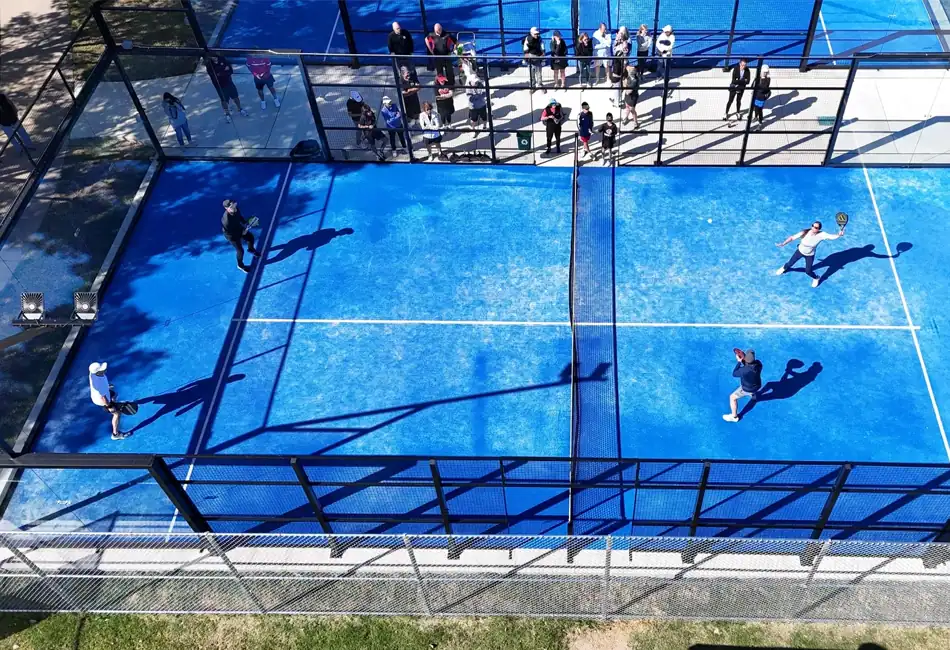
The board’s mission is tennis. Padel is something new. But the board had spent years watching what happens when you put a racket in the hands of a child that doesn’t have access to tennis, and it saw the same possibility in a new sport. “We’re a tennis foundation, not even a padel foundation,” O’Brien says, “but we just thought that this would be good for the community, and our foundation board members are truly invested in our community and believed that this could be a great asset for the entire region. Without their support and dedication, this project would not have been possible.”
The project took less than a year from idea to grand opening on October 19, 2025.
What the foundation has built over two decades is a set of programs designed specifically for children who would otherwise never encounter a racket sport. Its Summer Parks Program offers free tennis instruction at Memorial Park for children ages 6 to 18, running through June and July with five coaches and around 30 children a day. Its Spring Learn to Play series, run with local nonprofit Kids Inc. of Amarillo, serves kindergarten through sixth-grade students. The Window on a Wider World program is free for K-8 students. The foundation supports competitive tennis at six area high schools serving communities in the Texas panhandle, where the sport has historically had little presence:
“Those are all children that may never have the chance to try tennis,” O’Brien says. “The foundation is an effort at creating an entry point.”
For a child growing up in West Texas without family connections to the sport, tennis can feel like something that happens somewhere else, to other people. You don’t need to turn every child into a competitive player. You just need to show them the game exists and that there’s a place for them in it. The foundation board has believed that for 26 years. The padel courts are the latest version of the same idea.
That belief also shaped how the courts were run once they opened. Nina Pulliam came on as head pro and tightened the operation: more consistent scheduling, cleaner programming, stronger day-to-day engagement. More people playing, more often. Padel didn’t carry the facility on its own, but it added something the center didn’t have before: a different pace, a different look, and another reason for people to show up.
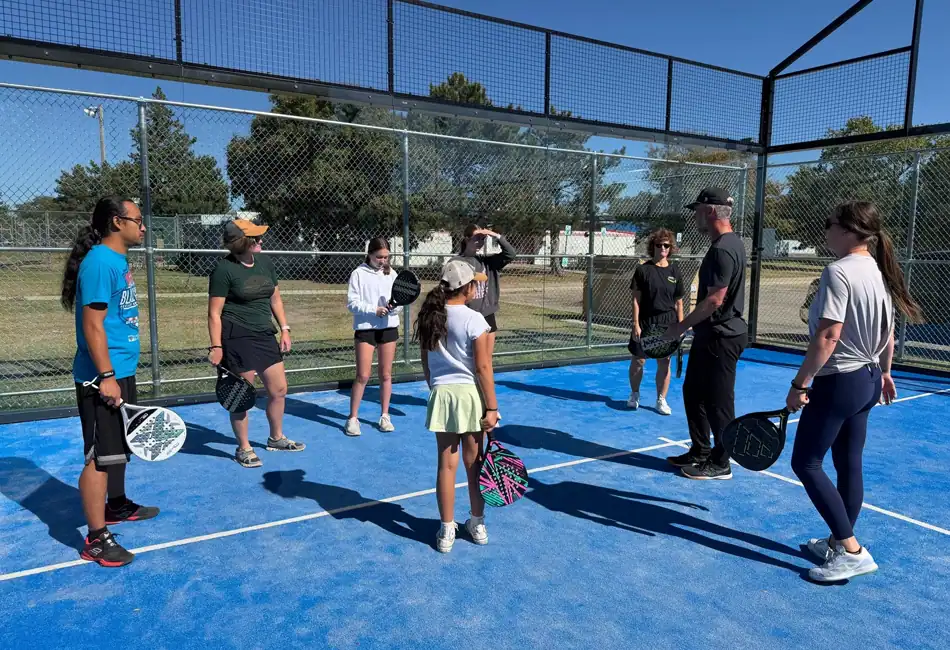
What’s happened since October bears that out. Pickleball players from adjacent courts have wandered over. Spanish-speaking players already familiar with the game have shown up. West Texas A&M athletes have turned the courts into a regular rotation. People stop mid-walk, watch through the glass, try to figure out the angles. “You start seeing the same faces come back, then they bring someone else,” O’Brien says. “That’s when you know it’s catching.”
Fellow player Daniel Cramer noticed something harder to measure. “It’s such an elegant court and a classy game,” he says. “It lifts the spirit at the center.”
O’Brien’s own introduction to padel was recent and, by his account, humbling. He picked it up about a year and a half ago in California and has begun traveling to other cities in Texas to play in tournaments and experience padel at different clubs. His tournament experiences have highlighted one of padel’s best aspects: its social nature.
“I met a lot of people I wouldn’t have crossed paths with otherwise,” he says. The comparison he keeps coming back to is golf. “You play for an hour and a half, hang out, and next thing you know, you’re talking about business, a deal, something you’re working on. That overlap, social, business, competition, that’s where it gets interesting.”
This summer, the foundation will add padel camps to its programming for the first time. The sport may prove easier to pick up than tennis for some children, and the public facility keeps the cost low enough that it doesn’t screen anyone out.
Padel has roughly 20 million players and about 40,000 courts worldwide, most of them in Europe and Latin America. The sport is still finding its footing in the U.S., with most activity concentrated on the coasts. Amarillo is something different: a city of about 200,000 people in the high plains of West Texas, where a nonprofit board with a long track record of showing up for underserved children looked at a new sport and decided it was worth the same investment they’d been making in tennis for 26 years.
The Amarillo National Tennis Center is at 5000 S. Bell Street. Court fees are $5 per player for 90 minutes of outdoor padel, tennis or pickleball, and $7 per player for indoor tennis. Annual memberships are $225 for adults and $125 for juniors. Hours are Monday through Saturday, 8 a.m. to 10 p.m., and Sunday, 1 p.m. to 7 p.m. More at aobtf.org.
Interview conducted by Scott Colebourne, Executive Director and CEO, United States Padel Association.